Continuous credential leak monitoring to combat cybercrime.
Credentials leak every day, from employee laptops and customer devices alike. Whiteintel matches yours continuously against one of the world's largest credential leak datasets: more than 15 billion exposed credentials and over 80 million stealer infection logs.
Know The Moment A Credential Leaks.
A periodic breach check tells you about last quarter. Continuous credential monitoring tells you about this morning, across your workforce and your customer base in the same place.
One of the World's Largest Credential Leak Datasets
More than 15 billion exposed credentials and over 80 million stealer infection logs, collected from infostealer malware, combolists, breach dumps and the forums where access is traded. Coverage is the whole game in credential monitoring: a leak you do not hold is a leak you cannot alert on.
Continuous, Not a Quarterly Snapshot
New logs land in the dataset as they are collected and your watchlists are evaluated against them continuously. Validity is resolved when you query, so you act on what is exposed right now rather than on a cached report that aged out weeks ago.
Workforce and Customer Accounts Together
Employee credentials and customer logins leak through exactly the same channels, so splitting them across two tools leaves gaps at the seam. Monitor your corporate domains and your consumer user base from one watchlist, with one set of alerts.
Credentials With the Device Behind Them
A leaked password on its own is a guess. We return the hostname, operating system, malware family and infection date that came with it, so you can tell a reused password from a live infection still siphoning sessions.
Session Cookies, Not Just Passwords
Stealer logs carry active session cookies that replay straight past multi-factor authentication. Continuous monitoring surfaces those tokens while they are still valid, which is the window where a password reset alone will not save the account.
Alerts Your Stack Can Act On
Every match is available by API, webhook and SIEM feed, carrying the fields your playbooks need to force a reset, revoke a session or open a ticket without anyone reading an email first.
From Leak to Locked Account
Continuous credential leak monitoring is a loop, not a report. Here is what runs between a credential leaking and the account being safe again.
Collect
We pull continuously from infostealer command and control servers, cloud-of-logs services, combolists, breach dumps and criminal forums, then normalise and deduplicate every record into one searchable dataset.
Match
Your watchlist of corporate domains, customer identifiers and executive accounts is evaluated against each new batch, so a match is found as the data arrives rather than when someone remembers to run a search.
Enrich
Each match arrives with the device and infection context behind it: hostname, operating system, malware path, the login URL the credential belongs to and whether a session cookie came with it.
Act
Alerts reach your team and your tooling at once, by API, webhook or SIEM feed, carrying everything a playbook needs to reset the password, kill the session and close the exposure.
Every field a credential match carries
A credential alert is only actionable if it tells you whose account it is, where it came from and whether it still works. Each match returns the full record, not just an email address.
{
  "identifier":   "[email protected]",
  "password":     "Au****24!",
  "login_url":    "https://sso.corp.com/login",
  "cookies":      ["session", "csrf_token"],
  "hostname":     "FINANCE-04",
  "os":           "Windows 11 Pro",
  "malware":      "Lumma",
  "malware_path": "C:\\Users\\mo\\AppData\\Local\\Temp\\up.exe",
  "source":       "stealer_log",
  "infected_at":  "2026-11-09T07:41:02Z",
  "first_seen":   "2026-11-09T11:18:44Z",
  "last_seen":    "2026-11-12T22:05:10Z"
}
See the platform in action.
Take a self-guided tour of Global Leak Search and see exactly what your team can do.

Global Leak Search
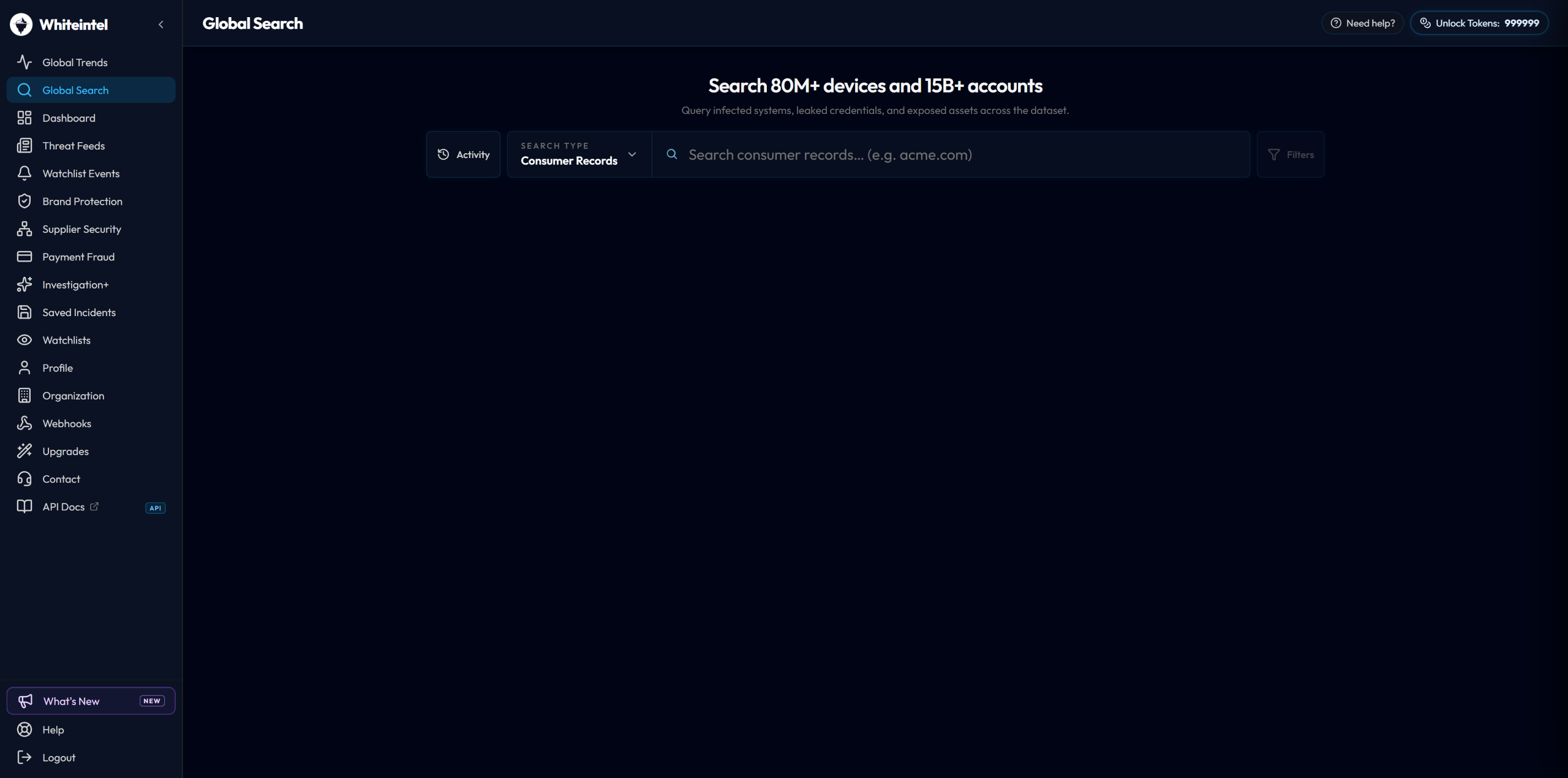
- Search 15 billion exposed credentials by domain, email, IP or password
- See employee and customer exposure from one place
- Check validity at query time instead of trusting a stale export
More than 100 enterprises worldwide trust our data to protect them







See what our customers are saying.
Verified reviews from CISOs, SOC managers, and security operations teams running Whiteintel in production.
Rich Data, Reliable API, and Prompt Personal Service
Whiteintel provides us a rich dataset through a reliable API that allows us to flag at-risk user accounts and protect our customers' data. The API performs as well, and service is always personal and prompt. The price point aligns well with the value it provides to our organization.
Get Started for Free
Dark web intelligence built on 15B+ exposed credentials and 25,000+ tracked threat actors. See what is already circulating about your organization, and shut it down first.
Continuous credential monitoring FAQs
Continuous credential monitoring is the practice of checking your organisation's credentials against newly leaked data constantly, rather than running a breach lookup every so often. A watchlist of your domains, customer identifiers and privileged accounts is evaluated against each new batch of leaked records as it is collected, so an exposure raises an alert when it appears instead of whenever someone next thinks to search. The distinction matters because stolen credentials are used quickly: by the time a quarterly report names an exposure, the account has usually been accessed or the password has long since been rotated for unrelated reasons.
A periodic check compares your accounts against published breach dumps at a point in time, which means it reports history and misses anything that leaked since the last run. Continuous monitoring ingests infostealer logs, combolists and forum data as they are collected and evaluates your watchlist against them on arrival. It also resolves validity at query time rather than serving a cached snapshot, so a credential that was rotated last week is not still sitting in your queue as an open finding.
Both, from one watchlist. Employee and customer credentials leak through the same infostealer infections and the same combolists, so monitoring them in separate products leaves a gap exactly where the two overlap, for example a contractor who uses the same password on a corporate portal and a customer account. Whiteintel matches corporate domains for workforce exposure and customer identifiers for consumer exposure in the same monitoring run, which is why this page exists alongside our enterprise protection and consumer protection pages rather than replacing either.
The dataset holds more than 15 billion exposed credentials and over 80 million stealer infection logs, alongside dark web forum posts, stolen payment cards and exposed secrets. It is one of the world's largest credential leak datasets, which matters for monitoring specifically because detection is bounded by coverage: a credential that is not in the dataset cannot generate an alert no matter how good the matching logic is.
Four main sources. Infostealer logs come from malware-infected machines and carry the richest context, including the device, the login URL and active session cookies. URL-login-password sets come from combolists and credential dumps, normalised and deduplicated. Breach data comes from published and traded dumps. Forum and marketplace monitoring covers the places where access is announced and sold. Each match records which source it came from, so you can weigh a stealer log from yesterday differently from a combolist entry of unknown age.
Because a stolen session cookie replays past multi-factor authentication. Resetting the password closes the credential but leaves a valid session token in the attacker's hands, which is the usual reason an account is still being accessed after a reset. Stealer logs capture these tokens along with the password, so continuous monitoring surfaces them while they are still live and the remediation becomes revoking the session, not just rotating the secret.
Matching runs against each new batch as it is ingested rather than on a fixed schedule, so alerts follow collection rather than a reporting cycle. Alerts are delivered by API, webhook and SIEM feed as well as email, so a match can trigger an automated password reset or session revocation without waiting for a person to open a dashboard.